

Custom/Patient-Specific Hip Replacement
-
Umar Burney, MD Dual Board-Certified Orthopedic Surgeon Fellowship Trained Joint Replacement & Sports Medicine
Dr. Umar Burney completed a sports medicine/Joint replacement fellowship under the Tutelage of Drs. Leland Winston and Thomas Clanton at the University of Texas Houston Medical School. Dr. Umar Burney is a Board Certified Orthopaedic Surgeon.
What is Custom/Patient-Specific Hip Replacement?
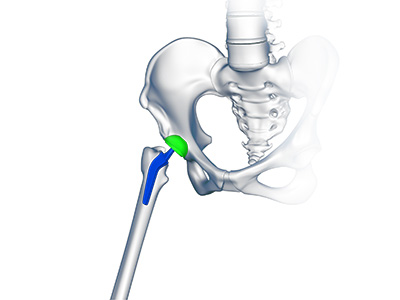
Custom total hip replacement or patient-specific hip replacement, is a newer, more advanced technology in total hip arthroplasty that uses an individualized hip implant for the replacement of the damaged or injured components of the hip joint. The hip implant is an artificial device used to restore the natural anatomy of the hip joint and improve or restore range of motion.
Custom total hip replacement requires a pre-operative CT scan of the hip joint. Using computer software, a virtual 3D model of the patient’s bone anatomy is generated to help the surgeon achieve greater accuracy in positioning the femoral and the acetabular components of the hip implant. The implant matches the size and orientation of the patient’s natural hip joint.
What is Anatomy of the Hip Joint?
The hip is a ball-and-socket joint made up of the head of the thigh bone or femur, that acts as the ball, and the rounded socket of the hip bone or acetabulum. The neck of the femur is the region just below the ball of the hip joint.
What are the Components of the Patient-Specific Hip Implant?
The hip implant includes a femoral component with a patient-specific neck, an acetabular cup, and a biocompatible plastic liner. The femoral head can be made of either ceramic or cobalt chrome.
The custom implant is designed such that its shape matches the patient’s bone defect/bone geometry and can adapt to the human body.
What are the Indications for Custom Hip Replacement?
Custom hip replacement is recommended for the treatment of the following:
- Large bone defects
- Leg-length discrepancy
- Severe hip joint deformation
- Pelvic discontinuity
- Complications related to existing implants
What is the Procedure for Custom Hip Replacement?
You will be administered general anesthesia. During the procedure, a surgical cut is made over the hip to expose the hip joint, and the femur is dislocated from the acetabulum.
- The surface of the femur is prepared by removing the arthritic bone and any soft tissue remnants using special instruments to create space to accommodate the femoral component of the implant.
- Similarly, the surface of the acetabular socket is cleaned, and the damaged or arthritic bone removed.
- Then the femoral head/neck component and acetabular component of the implant are placed into their respective grooves assisted by fixation screws, jigs, and medical imaging. The use of bone cement may be avoided.
- The incision is closed.
What are the Advantages of Custom Total Hip Replacement?
The custom hip implant offers numerous benefits, including:
- Adapts to the natural bone defect
- Improves hip alignment and joint movements
- Improves stability of the hip joint
- Maximizes the performance of the implant bearing
- Improves surgical accuracy
- Reduces the surgical time
- Improves survival of knee and hip implants
- Minimizes the need for revision surgery
What are the Risks Associated with Custom Hip Replacement?
Customized hip replacement is a relatively safe procedure. However, as with any surgery, there are certain risks involved that may include infection, bleeding, delayed healing, and loosening of the implant.
For more information about our services or to schedule an appointment, call us at or click here to request an appointment online. We'll respond to you as soon as possible.